www.facebook.com/share/56Fx4JBtL49dHuDf/

GRIEF (written by Tom Zuba)
This is a piece I wrote some time ago in response to an article in Parade Magazine about “complicated grief.” I’d love to hear your thoughts/feelings…
What if I told you that the appropriate, natural, even healthy response when someone you dearly love dies is to kick, scream, roll around on the floor, and foam at the mouth? Until you no longer have a need to do that. Well, it is.
But instead of the kicking and screaming, your doctor will now encourage you to take a pill to “take the edge off of it.” “No need to feel the pain,” he or she will say, when there’s a little pill for that.
And instead of rolling around on the floor and foaming at the mouth, many of us have bought into the mythical, iconic images of a graceful, dignified, and somehow-through-her-black-veil, still beautiful Jackie Kennedy navigating her husband’s funeral and burial. Images that travelled round the world and continue to hold power over us. By doing so, we’ve unknowingly and unconsciously set ourself up to create pain on top of pain. It’s now become the American way of doing grief. Pretending. Denying. Repressing. Staying strong. And sucking it all up. I call it the old way of doing grief. Trust me. It doesn’t work. I tried it three times. My 18-month-old daughter Erin died suddenly in 1990. My 43-year-old wife Trici died equally as suddenly in 1999, and my 13-year-old son Rory died of brain cancer in 2005. Along the way, I discovered a new way to do grief. A way rooted in hope with the promise of a full, joy-filled life.
We’ve forgotten that death is a normal part of life. We spend millions and millions of dollars because we’re so desperate to prolong life, regardless of the quality of life our beloved experiences during their last few days, or weeks, or even months. We call this love. It is not.
We’ve told ourselves over and over again that the death of a child is unnatural. Our mantra is now “No parent should have to bury their child.” We’ve conveniently forgotten that up until the beginning of the last century, due to advances in medicine, almost every family buried two or three or even four of their children before the kids reached the age of five.
In our attempt to get back to “the way things were” as quickly as possible, we’ve shortened the rituals surrounding death. We now need to wrap it up and tie it with a bow in three days or less, because most of us have to be back at work. A two or three day visitation and funeral where immediate family was supported by extended family, friends and neighbors has conveniently morphed into a quick and easy one-stop, no muss no fuss, sign the book so they know you were there; walk past the dead body or better yet, the ashes in a pretty urn; shake a hand with a bumbled “my deepest condolences;” and you’re back home in 15 minutes or so, if you timed it right. We will do anything and everything possible to make sure we never have to feel a feeling or express an emotion.
And now we’ve decided that grief is the enemy. A sickness. A disease. We need to label it and dissect it and give a time period – 365 days – before it becomes “complicated.” We’re being told that women have a harder time, and are more susceptible to “catching” complicated grief. Same scenario if the death of your beloved was sudden, or by suicide, or your beloved was a child, or God forbid, you’ve had multiple losses.
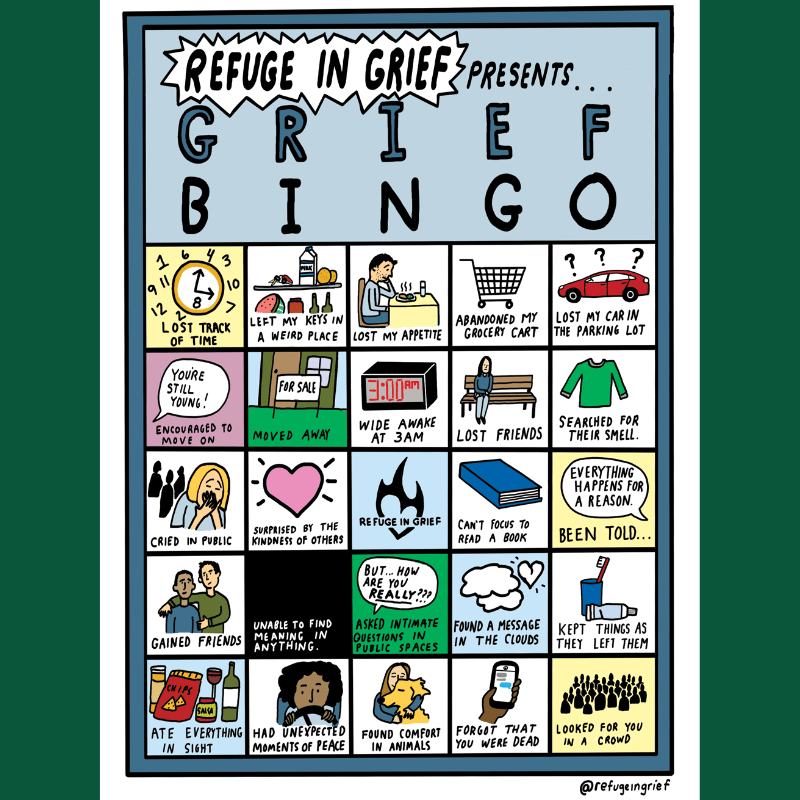
Grief is the automatic, internal response to loss. If you are human and you attach to people, places or things ~ a beloved, your job, your house, your car, your health, your youth, etc ~ and you lose that something, you will grieve. Everyone grieves. All the time. And grief expresses itself in countless number of confusing and surprising ways, such as sadness, and anger, and guilt, and numbness and confusion. Grief expresses itself though overeating or losing your appetite, through heart palpations and dizziness. Through loss of memory, and a strong desire to stay in bed, or work all the time or sit in a chair and stare. This is all grief. Most of us don’t know much about it. How would we? We pretend it doesn’t exist. We never talk about it, until it is our turn to navigate the journey.
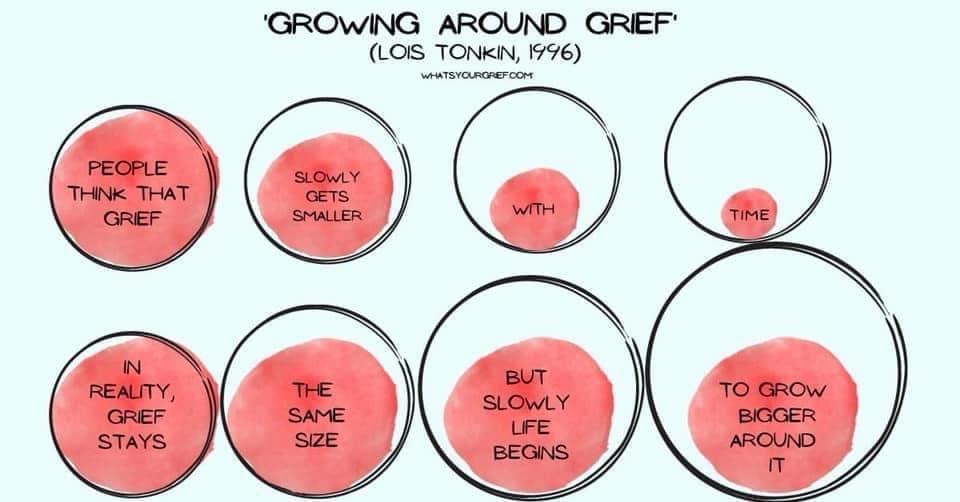
Although, the very nature of grief is wild, and unpredictable, and nonlinear, and yes, cruelly complicated, grief is not the enemy. Grief is not to be avoided at all costs. Grief can be the great teacher, when we let it.
We heal from all the losses we experience when we mourn; when we identify what is occurring on the inside and push it up and out. This is the new way to do grief. We mourn when we externalize the internal. The problem is, however, that most of us are given 3-5 days to mourn and then it’s back to work and back to “normal.” It’s the message we get over and over from our boss, our family members, our friends and our colleagues. They don’t know any better, and won’t until it is their turn. They are innocent and ignorant.
When someone we dearly love dies, a part of us dies too. The part dies that was wrapped up in the plans and wishes and dreams we had for our life with our beloved, be that a child, a spouse or partner, a parent, or a dear family member or friend. Life will never go back to the way it was. The challenge, and the opportunity is to create a new life. A life that is richer because we were capable of loving, deeply. A life that is more compassionate, and kinder, and more gentle. A life filled with gratitude for what is.
Healing occurs when we mourn in a safe, sacred space where we get to feel every feeling and emotion that arises. A space where we feel loved and lovable, and where we are seen, heard and honored. Sadly, we no longer create this space for ourself and we certainly don’t create that space for each other. Therefore, most of us no longer mourn. And that’s why our grief journey may get complicated. It’s not the grief that’s complicated. Grief is natural and normal. It’s the lack of understanding, love, compassion, kindness, gentleness and the willingness to accompany another person on their journey that complicates the journey. We can do better.
💛💛💛
PLEASE share so the others will know.
My first book
Permission to Mourn
is available at amazon:









 Gina’s thoughts on life, death, and in between